
How Crystals Are Formed
At its most basic level, a crystal is a solid material whose atoms are arranged in a repeating, orderly pattern. This structure forms naturally within the Earth over long periods of time, often under intense heat and pressure. Because of this internal order, crystals grow in recognizable shapes and carry a stable, consistent structure.
But that is only part of the story.
For centuries, across cultures and spiritual traditions, crystals have been viewed as living records of the Earth’s memory. They are formed slowly, patiently, and with purpose. Many believe this steady formation is why crystals are often associated with balance, grounding, clarity, and energetic support.
Crystals sit at the intersection of science and spirit. They are geological wonders, and they are also symbolic tools that help us focus intention, awareness, and healing.
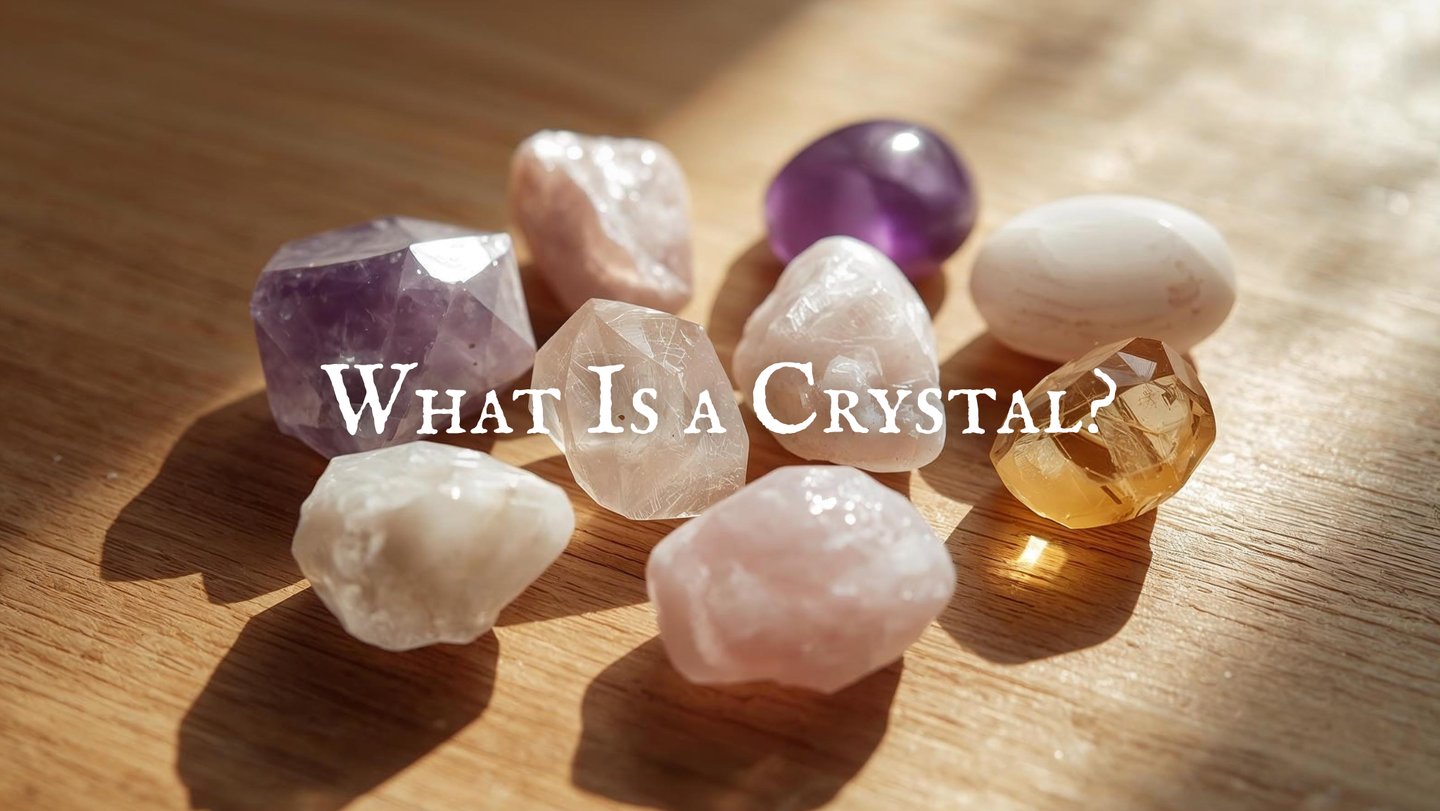


Crystals form when minerals cool, solidify, or crystallize from molten rock, water solutions, or vapor. As they grow, their atoms lock into precise geometric patterns. This internal order is what gives crystals their strength, symmetry, and unique energetic qualities.
Some crystals grow deep within the Earth’s crust over millions of years. Others form in water-rich environments, slowly crystallizing as minerals settle and bond. Each formation process leaves its own imprint, influencing the crystal’s appearance, hardness, and energetic feel.
This long, deliberate creation is why many people experience crystals as steady, grounding allies. They hold the energy of time, pressure, and patience.
Categories of Crystals
Crystals can be grouped in a few helpful ways, depending on how you are studying or working with them.
1. Mineral Crystals
These are naturally occurring crystals formed from single minerals or mineral compounds. Examples include quartz, calcite, and fluorite. They are often used for clarity, amplification, and energetic balance.
Crystals grow in specific geometric systems based on their internal atomic structure. These systems include cubic, hexagonal, tetragonal, orthorhombic, monoclinic, triclinic, and trigonal. Many crystal practitioners believe these shapes influence how energy moves through the stone.
2. Crystal Systems
Not all stones are single crystals. Some are made of many crystals growing together, or minerals that did not fully crystallize. These stones often carry blended energies and are valued for grounding and stability.
3. Stones and Aggregates
4. Metamorphic and Igneous Stones
Some stones form through heat, pressure, or volcanic activity rather than slow crystallization alone. These are often associated with transformation, strength, protection, and rebirth.
While not technically crystals, stones like amber, jet, and pearl are often included in crystal work. They come from organic origins and are deeply connected to life cycles, protection, and ancestral energy.